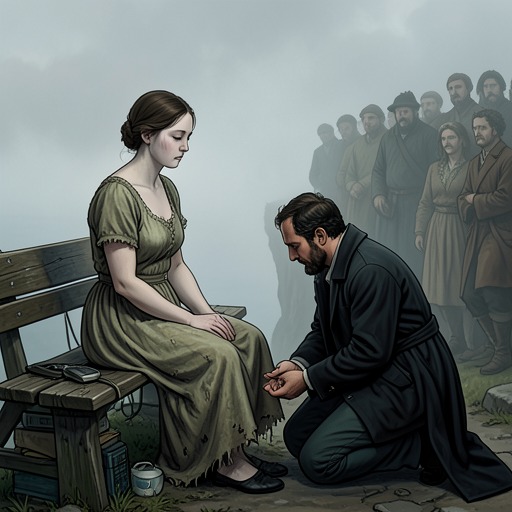
Lea Marquis–Henri le Clerc relationship
The Pale Blue EyeThe relationship between Lea Marquis and Henri le Clerc is the story of an illness interpreted as a gift, and of a promised cure that leads Lea toward sacrifice. As her spells worsen, she tells her family she has met a gentleman; her father identifies him as their ancestor and healer. Henri then becomes, in the family’s understanding, a source of instruction and hope. Yet the account never settles whether he is truly present or whether Lea and her family give an imagined figure authority over their lives.
The Figure in the Portrait
Lea’s father, Dr. Daniel Marquis, tells Augustus Landor that Lea’s spells became much worse when she was twelve. On one afternoon in July, she came to herself and said that she had met someone: “A gentleman.” Asked whether this was Father le Clerc, Dr. Marquis agrees. Landor calls Henri her great-great-great-grandfather, while Dr. Marquis’s own qualification—“or whoever he was”—leaves the precise family connection uncertain.
The family’s explanation grows out of a portrait. Dr. Marquis says he kept it in the attic and that Lea and Artemus Marquis had come across it there. The image gives Lea a means to identify the gentleman she says she has encountered, though it does not establish that an encounter took place. Dr. Marquis insists that Henri was not evil as he had been reputed to be, but a healer who had been misunderstood. His defense of the ancestor helps explain why the family could treat the figure not as a threat but as a possible source of aid.
Lea was fluent in French, and Dr. Marquis confirms that she could speak with Henri in that language. For her father, this detail belongs to the account of a real meeting; for Landor, it does not resolve the mystery. The distinction matters: the family’s conviction gives Henri influence, but the account reaches the reader through Landor’s questioning and the family’s recollections, not through independent confirmation of the spirit’s presence.
From Lea to the Family
Henri’s supposed authority does not remain confined to Lea. Landor reconstructs a chain in which the figure instructs her, Lea in turn instructs Artemus, and at some point Dr. Marquis’s wife also becomes a student. Dr. Marquis’s reaction to this suggestion persuades Landor that he has guessed correctly, although Landor acknowledges that he has no written proof of the mother’s participation. In this way, Lea becomes both the person seeking help and the channel through which Henri’s teachings enter the household.
The family’s secrecy and withdrawal form the setting for that expanding influence. Dr. Marquis tries medical regimens without success and also brings in faith healers, but neither approach stops the terror surrounding Lea’s spells. Over time, the illness changes the whole family: they leave the comforts of New York City for the isolation of West Point, abandon friendships, and keep largely to themselves. Dr. Marquis gives up his ambitions, his wife grows bitter and eccentric, and the children develop unusually close bonds while largely left to one another. Their fear of being shunned helps explain why they do not tell others what is happening and why Henri’s promise can become an inward family authority.
The family’s account presents Henri as a healer rather than a malign ancestor, but Landor sees a darker progression in the lessons attributed to him. He characterizes their curriculum as sacrifice, beginning with animals and advancing to the point where animals would no longer suffice. That interpretation places the relationship between Lea and Henri at the center of a household system: what begins as one girl’s claimed contact becomes a shared belief with practical and increasingly dangerous consequences.
A Cure and a New Condition
Dr. Marquis says Henri promised Lea a cure if she did what he asked. She complied, and, in her father’s view, her condition improved: the spells became less frequent and less severe. The improvement gives the promise credibility within the family. It also complicates the idea of the relationship as simple coercion. Lea and her family have endured failed medical treatment and failed faith healing; Henri’s instructions appear to offer a result where other efforts have not.
But improvement is not freedom. When Landor asks why Lea would want a human heart if her health was already improving, Dr. Marquis says she wanted none of it at first. Henri had told her that a heart was the only way to be free once and for all. Dr. Marquis describes what she sought as release from a condition she understood both as a curse and as a gift: she wanted to be whole and to live as other women did, and she wanted to love. The promise thus changes from relief of symptoms to final deliverance, extending Henri’s authority even after the spells have become less severe.
The Final Rite
At the ceremony Landor witnesses, Lea appears among the figures gathered around a rough-hewn rock altar. She speaks in a voice of unusual resonance, in what Landor believes is a newly made language belonging to Lea and Henri le Clerc. The scene preserves the uncertainty surrounding their relationship: Landor reports what he sees and hears, but his account does not establish whether Henri is literally speaking through or with Lea, or whether the language is part of the family’s ritual belief.
The rite’s movement gives concrete form to the bargain. Lea carries a vessel to the altar, pours blood over her head, and asks, “Great Father. Release me from thy gift. Release me, O Most Merciful Father.” She then takes a small wooden box from a niche in the stone wall and displays its contents to her companions. The preserved heart is the object around which the promised final cure has gathered. The scene does not make the cure’s success a fact; it shows Lea asking to be released and the family proceeding with the means they believe Henri has prescribed.
Significance and Uncertainty
Henri le Clerc’s place in Lea’s life rests on a tension the story does not resolve: the figure may be an ancestor who offers instruction, or an imagined presence interpreted through illness and reinforced by family belief. The portrait, Lea’s French fluency, her father’s testimony, and the reported reduction in her spells all help the family sustain its account, but none independently proves the supernatural explanation. Landor’s own reconstruction likewise mixes confirmed testimony with inference, especially when he attributes the teachings to a family-wide circle.
The relationship’s decisive consequence is therefore not simply that Lea believes she has met an ancestor. Henri’s promise turns her desire to be well into obedience to a demand for sacrifice, while the family’s isolation allows that demand to gain force without outside scrutiny. At the altar, Lea’s plea to be released from a gift condenses the contradiction at the heart of the bond: what had seemed to heal her has also become the condition from which she seeks deliverance.